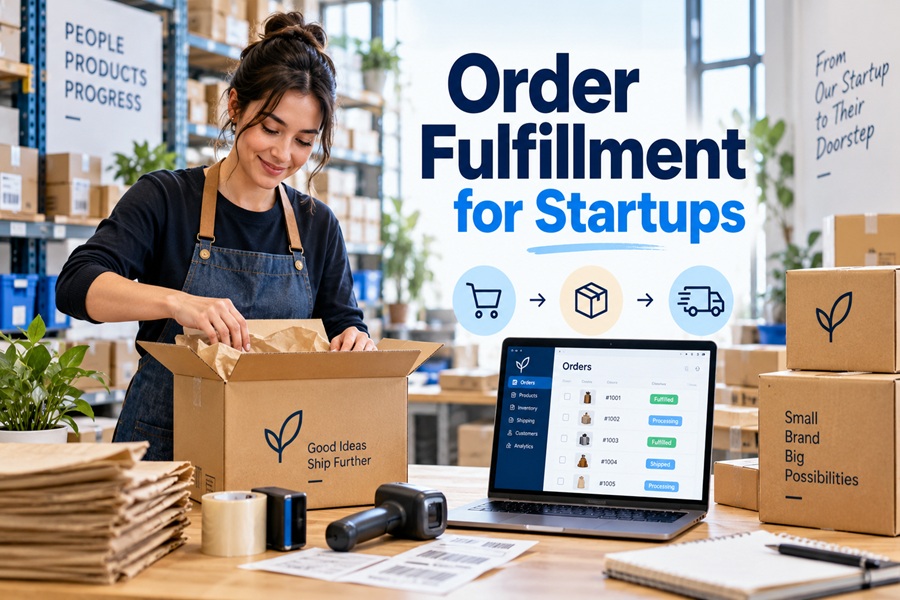
Nobody starts a brand because they love packing tape. Yet for most product startups, fulfillment often decides whether customers come back. A late box, a crushed product or a surprise shipping fee will undo a great Instagram ad faster than anything else.
Order fulfillment covers everything that happens after someone clicks “buy.” That means receiving inventory, storing it, picking the right item, packing it, shipping it and handling returns. The smartest approach is not fixed. It changes as the company grows, and the most expensive mistakes usually come from staying in one stage too long or jumping ahead too early.
Stage One: The Kitchen Table
Most startups begin by doing it themselves. Inventory lives in a spare room or garage, orders print each morning and the founder drives to the post office.
This stage has real advantages. Costs are low, you see every order and you learn exactly how your product survives shipping. Many founders discover packaging problems here that would have been expensive to fix at scale.
A few habits make self fulfillment far less painful:
- Use shipping software that connects to your store and buys discounted labels instead of paying retail counter prices.
- Standardize two or three box sizes so you are not guessing every time.
- Keep a simple inventory spreadsheet or use your store platform’s inventory tracking.
- Batch your packing at a set time each day rather than reacting to every order.
The ceiling usually arrives somewhere between 10 and 30 orders a day, or whenever packing starts eating the hours you should spend on marketing and product.
Stage Two: Help Without a Warehouse
Before signing a fulfillment contract, many startups try a middle path. A part time packer, a rented storage unit or a small shared workspace can stretch the do it yourself model for a few more months.
Some founders also use dropshipping or print on demand for part of their catalog. These models hold no inventory at all. The supplier ships directly to the customer. They are great for testing new designs, but margins are thinner and you control less of the unboxing experience.
Stage Three: Bringing in a 3PL
A third party logistics provider, or 3PL, stores your inventory in its warehouse and ships orders on your behalf. For many startups this is the biggest operational decision of the first few years.
Here is how the main options compare.
| Model | Upfront cost | Control | Scales well? | Best fit |
|---|---|---|---|---|
| Self fulfillment | Very low | Complete | No | Early testing, under roughly 30 orders a day |
| Dropshipping or print on demand | None | Low | Yes | Testing products, wide catalogs |
| Third party logistics (3PL) | Moderate | Medium | Yes | Growing brands shipping steady volume |
| Amazon FBA | Moderate | Low | Yes | Brands selling heavily on Amazon |
| Own warehouse | Very high | Complete | Yes, with capital | Larger brands with stable volume |
A typical 3PL bill includes receiving fees when inventory arrives, monthly storage by pallet, bin or cubic foot, a pick and pack fee per order, packaging materials and the shipping label itself. Some providers add account minimums or integration fees.
Shipping is usually the largest piece. Industry benchmarks suggest the carrier label alone often makes up half or more of total fulfillment cost for direct to consumer orders. A 3PL with negotiated carrier rates can sometimes save enough on postage to offset its own fees.
Signs It Is Time to Switch
Watch for these signals:
- Founders spend more than a day a week packing boxes.
- Shipping errors or late orders are creeping up.
- You are missing out on two day delivery promises your competitors make.
- Inventory has outgrown the space you have.
- You are about to launch on a new channel such as wholesale or a marketplace.
Choosing a 3PL Without Regret
Not every 3PL wants a small startup, and not every startup fits a big provider. Ask direct questions before signing.
- What are the monthly minimums? Some providers require a minimum spend that a young brand cannot hit.
- Which platforms do you integrate with? Shopify, WooCommerce, Amazon and TikTok Shop connections should be plug and play.
- Where are your warehouses? A location near your customer base cuts shipping zones and delivery times.
- How do you handle returns? Ask for the process and the fee per return.
- Can you do custom packaging or inserts? Branded boxes and thank you notes often cost extra.
- What happens if I leave? Check contract length and fees for pulling inventory out.
Ask for references from brands at a similar size. A provider that delights large accounts may treat a 50 order a day client as an afterthought.
Costs That Catch Founders Off Guard
Dimensional weight. Carriers charge based on box size as well as weight. An oversized box for a light product can double the label cost.
Long term storage. Slow moving stock sitting in a warehouse for months gets expensive, especially with providers that charge extra after a set period.
Import costs. For startups manufacturing overseas, landed cost has changed. The United States ended the duty free de minimis treatment for low value imports in August 2025, so small shipments that once entered without duties now generally owe them. That affects brands that shipped directly from overseas suppliers to customers.
Peak season surcharges. Carriers add fees during the holiday rush, and some 3PLs pass along extra labor costs too.
Fulfillment as Part of the Brand
Speed and accuracy matter, but so does the moment a customer opens the box. Startups that win on fulfillment usually treat it as part of marketing. That can mean right sized packaging, a short handwritten style note or a simple card explaining how to use the product.
Clear communication fills the rest of the gap. Automatic tracking emails, honest delivery estimates and an easy returns page reduce “where is my order” messages and build trust.
A Simple Way to Plan Ahead
Write down three numbers today: your average orders per day, your average fulfillment cost per order and the number of hours your team spends on fulfillment each week. Review them every month.
When the hours climb faster than the orders, or the cost per order stops falling as volume grows, it is time to move to the next stage. Startups that plan that move before the holiday rush, rather than during it, tend to avoid the worst week of their year.
Leave a Reply