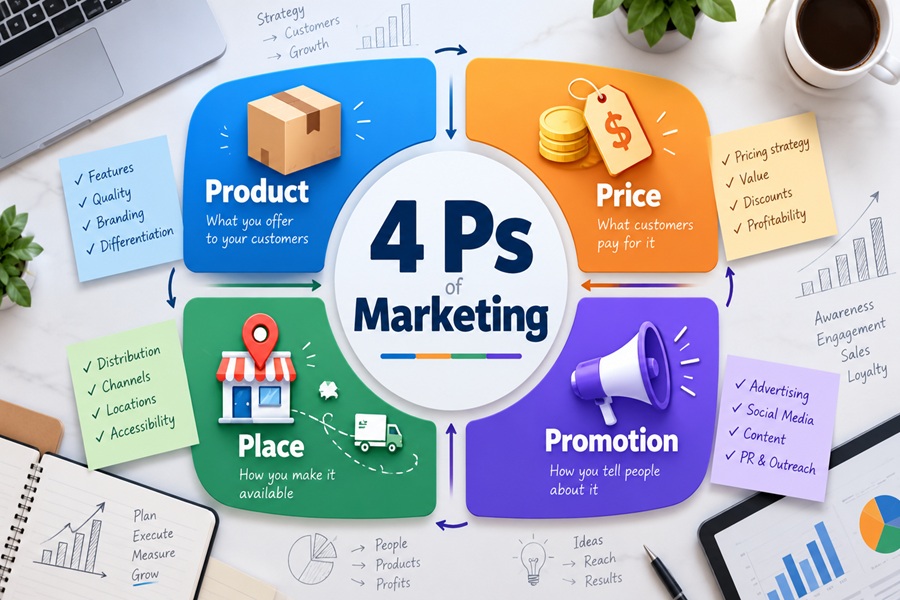
Imagine you are about to open a small bakery. Before the first loaf is baked, you will have already answered four questions, even if you never wrote them down. What exactly are you selling? What will you charge? Where will people find it? How will they hear about you?
Those four questions are the 4 Ps of marketing. They are called the marketing mix, and the idea is that product, price, place and promotion are the levers a business can actually control. Everything else, from the economy to a competitor’s sale, you can only react to.
A short history, because it explains the shape
The framework is credited to E. Jerome McCarthy, who set it out in 1960. Earlier thinkers had talked about a long list of marketing variables, and McCarthy boiled them into four easy to remember words. The simplicity is the reason it survived. A student can learn it in a minute and a founder can use it in a meeting the same afternoon.
Product: what problem are you solving?
Product covers the thing itself plus everything wrapped around it, including quality, features, design, packaging, brand name, warranty and support. Customers rarely buy a feature list. They buy relief from a problem.
Back at the bakery, the product is not simply bread. It might be fresh sourdough that is ready before office hours, with a subscription so nobody has to remember to order. Good product thinking starts by asking who the buyer is and what job they are hiring your offer to do.
Price: what is it worth, and to whom?
Price is more than a number on a label. It signals quality, sets expectations and decides which customers you attract. Common approaches include cost plus pricing, competitor based pricing, value based pricing, penetration pricing for new entrants and premium pricing for status products.
A price that is too low can make a good product look suspicious. A price that ignores what rivals charge can make it invisible. Discounts, payment plans and bundles belong here too, since each one changes how the price feels.
Place: how does it reach the customer?
Place means where and how your product becomes available. That includes physical shops, distributors, marketplaces, your own website and apps. In the past it was mostly about shelf space. Today it also covers search results, social platforms and delivery speed.
The bakery could sell from a counter, through a delivery app, at a weekend market and through office tray orders. Each route has different costs, margins and customer expectations. Choose the places where your buyers already spend time rather than hoping they will travel to you.
Promotion: how will people find out?
Promotion is every effort to communicate the value of your offer: advertising, public relations, content, email, social media, events, influencer partnerships and sales promotions. The aim is not noise. It is relevance, meaning the right message in front of the right person at a useful moment.
Seeing the four together
| The P | The core question | Traditional example | Digital era example |
|---|---|---|---|
| Product | What are we offering? | A packaged item on a shelf | Software with free trials and regular updates |
| Price | What will it cost? | A fixed sticker price | Subscription tiers and dynamic offers |
| Place | Where can it be bought? | Retail stores | Websites, marketplaces and mobile apps |
| Promotion | How do we spread the word? | Print and television | Search, social video, email and creators |
The most important rule is that the four must agree with each other. A luxury product with a bargain price and a discount store location sends a muddled message, and customers notice.
Where the 4 Ps start to strain
By the 1980s, thinkers working on services argued that four Ps were not enough. Booms and Bitner proposed three more, giving the 7 Ps:
- People, meaning the staff and customers who shape the experience.
- Process, meaning the steps a customer goes through to buy and receive value.
- Physical evidence, meaning the tangible or visible proof of quality, from shop interiors to website design and reviews.
For a restaurant, a clinic or a software company, these extra three often decide whether customers return.
Another view flips the lens from seller to buyer with the 4 Cs: customer value, cost to the customer, convenience and communication. Instead of asking what you want to push, it asks what the buyer needs to feel. Many marketers use both lists side by side, one for planning and one as a reality check.
How the mix looks in 2026
Digital channels now take a large share of marketing budgets, and the Ps behave differently because of it.
- Product is shaped by feedback loops. Reviews, usage data and quick updates mean a product can improve while it is already on sale.
- Price can be tested and personalized more easily, though customers punish pricing that feels unfair.
- Place now includes AI generated answers and assistants that recommend products. Being easy for those systems to understand has become part of distribution.
- Promotion has moved toward value led content, short video and creator partnerships, with privacy rules limiting how much tracking is possible.
A practical way to use the framework
Take a pen and answer these in one sentence each for your own business. Who exactly is the product for? What price band fits the value we deliver? Which two places should we focus on first? Which one or two promotion channels can we do well rather than five badly? Then read the four answers together. If they sound like four different companies, you have found your first fix.
Common slips
- Treating the 4 Ps as a checklist to fill in once instead of a mix to revisit.
- Setting a price without checking what customers believe the product is worth.
- Choosing places because they are fashionable, not because buyers are there.
- Spending on promotion before the product is ready to impress.
Why a sixty year old idea still earns its place
The 4 Ps do not tell you what to decide. They tell you what must be decided, and that is more useful than it sounds. Whether you are opening a bakery or launching an app, the four questions will still be waiting, and the businesses that answer them on purpose usually beat the ones that answer by accident.