A sales rep leaves a company on a Friday. By the following month, a marketer is staring at a shared sheet trying to work out which of 400 warm prospects had asked for a quote, which had gone quiet and which were still waiting for a callback. The notes were in the rep’s head. The relationships, it turns out, were never really the company’s.
That small disaster explains why CRM marketing exists. It is the habit of treating every customer interaction as information that the whole business can use, rather than something that lives in one inbox.
So what is a CRM marketing strategy?
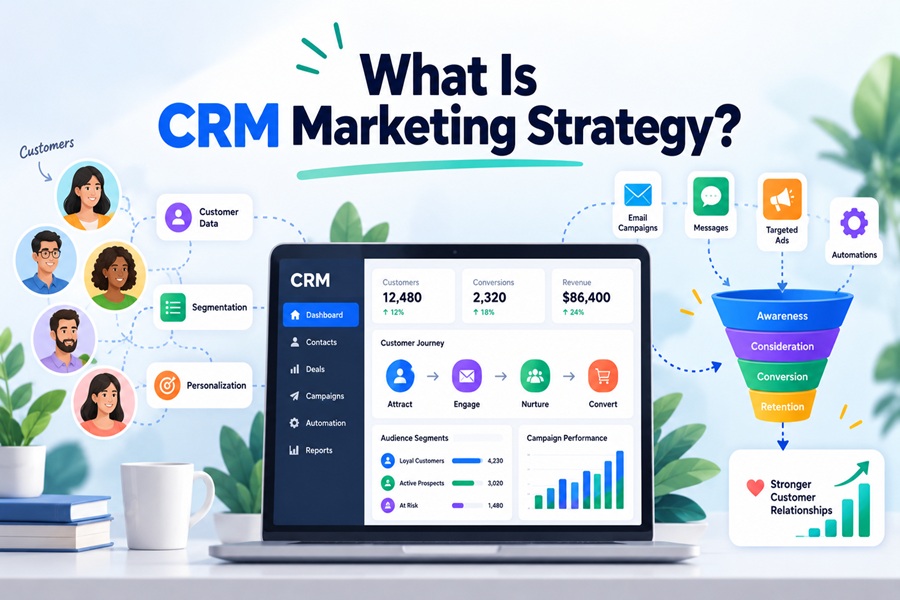
A CRM marketing strategy is a plan for using the information stored in your customer relationship management system to decide who you talk to, what you say, when you say it and through which channel. The software holds the records. The strategy is the set of goals, rules and routines that turn those records into campaigns, follow ups and better service.
Ordinary marketing asks who might buy. CRM marketing asks a different question: what do we already know about this person, and what should happen next? The second question is cheaper to answer, more respectful of the customer’s time and far easier to measure.
Why teams keep moving toward it
Roughly nine in ten marketing organizations now run on a CRM, and studies of adopters report an average gain of about 25 percent in marketing return. Among marketers who work without one, only around half say their strategies feel effective. Emails personalized from CRM data have been measured with click through rates about 14 percent higher than generic sends, and well executed personalization is linked to revenue lifts of 10 to 15 percent.
These figures come from different studies with different methods, so read them as direction rather than promise. The pattern, though, is consistent. Teams that know their customers tend to waste less money talking to the wrong people.
Building one in six moves
1. Pick the business question before the tool. Are you trying to shorten the sales cycle, bring back lapsed buyers, lift repeat purchases or reduce churn? One clear question shapes every field you create afterwards.
2. Clean what you already hold. Duplicate contacts, missing lifecycle stages and half filled company names quietly ruin segmentation. AI features inside a CRM cannot fix history it does not trust, so spend a week on hygiene before you spend a month on automation.
3. Choose the attributes you will really use. Ten to fifteen is plenty. Industry, product tier, lifecycle stage, last activity and renewal date usually cover most needs. Every extra field is one more thing someone must keep fresh.
4. Segment by behavior, not only by profile. A job title tells you who someone is. A pricing page visit, a downloaded guide or an abandoned quote tells you what they want right now.
5. Map journeys with triggers. Write down the events that should start a conversation: a signup, a first purchase, thirty days of silence, an approaching renewal. Then decide the message, channel and owner for each.
6. Share one scoreboard. Marketing, sales and support should read the same customer record and report against the same definitions. Three dashboards with three opinions is not a strategy.
What the data is actually for
| Data point | What marketing does with it |
|---|---|
| Lifecycle stage | Decides whether someone gets education or an offer |
| Last purchase date | Triggers replenishment reminders or a win back message |
| Content viewed | Chooses the topic of the next email |
| Open support ticket | Pauses promotions until the issue is closed |
| Source channel | Shows which spend produces customers, not just clicks |
| Renewal date | Starts the retention sequence early enough to matter |
Notice that none of these require guesswork. They only require that someone captured the information and that the system connects it to an action.
What has changed in 2026
The biggest shift is that AI inside CRM has moved from advising to acting. Autonomous agents can now qualify leads, update records and trigger follow ups without waiting for a person to click. Around eight in ten companies report using AI for automation or personalization within their CRM, and teams using AI driven lead handling report noticeably faster response to new enquiries.
Personalization has matured as well. A first name in a subject line no longer counts. Real time behavioral signals, such as what someone browsed this morning, now drive which message appears and on which channel.
There are honest limits. Poor data quality remains the main brake on AI results. Security teams worry that autonomous agents widen the attack surface. Privacy rules in many regions demand clear consent and easy opt outs. A smart strategy treats these as design inputs, not afterthoughts, and keeps a human ready to take over whenever a conversation turns sensitive.
A small business does not need an expensive platform to start. A modest CRM with clean contact records, a few meaningful tags and two or three automated follow ups will outperform a complex system nobody maintains. Grow the setup only when a real customer need asks for it, and train everyone who touches the data so that records stay consistent from the first day.
Mistakes worth avoiding
- Buying software first and defining goals later.
- Letting sales and marketing maintain separate versions of the same contact.
- Personalizing so aggressively that customers feel watched.
- Collecting data without recording consent.
- Judging success by email opens alone.
Measuring whether it works
Pick a short list and review it every quarter. Customer lifetime value, retention rate, repeat purchase rate, lead to customer conversion, revenue per segment and speed of first response give a fair picture. If a metric does not change a decision, drop it.
The quiet advantage
A CRM marketing strategy rarely looks dramatic from the outside. Customers simply notice that your messages arrive at sensible moments, that nobody asks them to repeat themselves and that renewals do not come as a surprise. That quiet sense of being remembered is hard for competitors to copy, and it starts with the unglamorous work of keeping good records and acting on them.