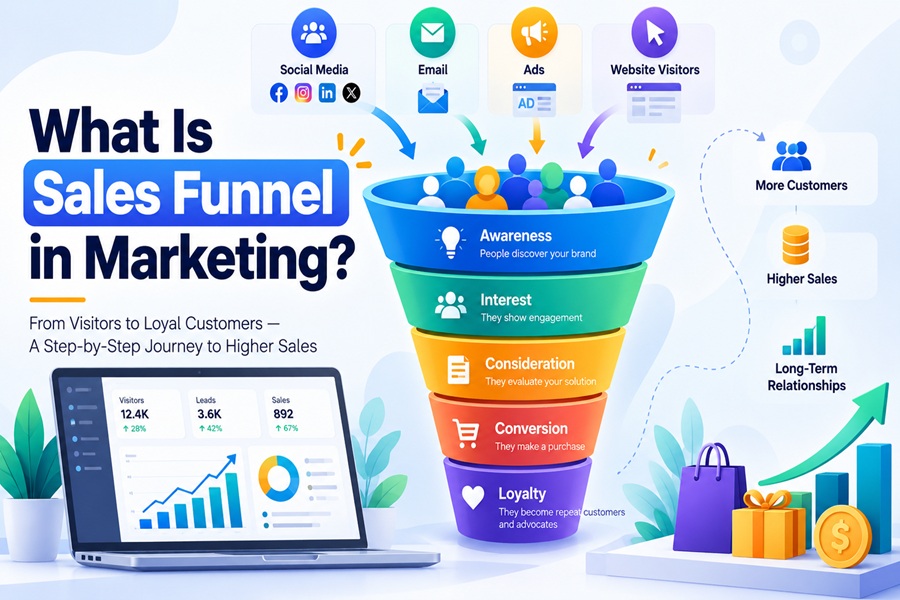
The sales funnel is usually traced back to 1898, when an advertising pioneer sketched the steps a buyer moves through: attention, interest, desire and action. That is a hundred and twenty eight years of use, which is odd for a diagram that never once showed what customers actually do. Yet it remains the skeleton behind most CRM stages and marketing reports today.
So what is a sales funnel in marketing? It is a model of the path a person takes from first hearing about you to becoming a customer, drawn as a funnel because many people enter at the top and far fewer come out of the bottom. Each stage filters the crowd, and your job is to understand why people drop away.
The classic three layers
Marketers usually split the funnel into three zones.
Top of the funnel (awareness). People have a problem or curiosity but do not know you. Blog posts, social videos, search results, podcasts and word of mouth do the work here. The goal is to be noticed for the right reason.
Middle of the funnel (consideration). They know the category and are comparing choices. Case studies, webinars, comparison pages, email courses and free tools help them judge fit.
Bottom of the funnel (decision). They are close to buying. Demos, free trials, quotes, clear pricing and reassurance on risk move them over the line.
Many teams add stages after the sale: onboarding, retention and advocacy. A customer who stays and recommends you is worth more than one who buys once.
A closer look at a B2B version
| Stage | What the buyer is thinking | What helps |
|---|---|---|
| Visitor | “Something is wrong, what is it?” | Educational content, search visibility |
| Lead | “These people seem useful.” | Guides, newsletters, gated tools |
| Marketing qualified lead | “I might need this.” | Targeted nurture emails |
| Sales qualified lead | “Can they solve my case?” | Discovery calls, tailored demos |
| Opportunity | “How do we compare options?” | Proposals, references, trials |
| Customer | “Did we choose well?” | Onboarding, support |
| Advocate | “Others should know.” | Reviews, referral programs |
The first few stages usually belong to marketing, while the middle and later ones sit with sales. Trouble starts when each team defines the stages differently.
What the leaks look like in numbers
Published benchmarks paint a humbling picture. A typical B2B funnel converts roughly 1 to 3 percent of website visitors into leads, which means 97 to 99 percent leave at the very first step. Reports suggest that 60 to 70 percent of sales qualified leads never turn into real opportunities, and that most leads fail to convert simply because nobody nurtured them. Some research finds that about two thirds of businesses have still not fully documented their funnel.
These numbers vary by industry and method, so use them to sense the scale of the problem rather than as targets. The lesson is that a small improvement near the top or a better follow up in the middle can change results more than doubling traffic.
The buyer stopped following the diagram
Here is the uncomfortable part. Modern buyers do not walk down a neat tube. Surveys indicate roughly three quarters of B2B buyers prefer to research alone before talking to a salesperson. They read reviews, ask peers, watch videos, compare features and increasingly ask AI assistants, all before leaving a trace you can see.
This hidden research is called the dark funnel. It covers private chats, communities, podcasts, peer recommendations and AI answers, none of which show up neatly in analytics. A buyer may spend months forming an opinion before a first tracked visit, so a sales cycle that looks like six weeks on your dashboard may really be closer to five months.
How do you work with something you cannot measure? You show up where decisions are shaped:
- Publish genuinely useful, specific content so that you are remembered and cited.
- Collect reviews and customer stories, since peers trust peers.
- Ask new customers how they first heard of you, in their own words, and record the answers in your CRM.
- Make your pages clear and well structured so search and AI systems can describe you accurately.
Funnel or flywheel?
A popular alternative treats growth as a wheel: attract, engage, delight, with happy customers adding momentum through referrals and reviews. The funnel stops at the sale, while the flywheel loops back.
Neither is wrong. The funnel is excellent for diagnosis, because it shows where people drop away. The flywheel is better for strategy, because it reminds you that retention fuels acquisition. A sensible team uses the funnel to measure and the flywheel to decide where to invest.
How to build or repair yours
- Draw the real journey. Pull records from your CRM and note how your last twenty customers actually found you and decided.
- Define each stage once. Marketing, sales and finance should read from the same definitions.
- Match content to stage. A pricing sheet is wasted on a stranger, and a beginner blog post is wasted on someone ready to sign.
- Measure the drop between each pair of stages. The biggest drop is your first repair, not the one that is easiest to fix.
- Speed up follow up. Replying quickly to interested leads is one of the cheapest improvements available.
- Review monthly. Journeys change, and so should your funnel.
Mistakes that keep the leak open
- Counting every form fill as a qualified lead.
- Chasing traffic while ignoring conversion rates.
- Treating the sale as the finish line.
- Keeping stages for forecasting but never asking what the buyer is trying to accomplish.
- Letting two teams argue over numbers that were never defined the same way.
The honest summary
A sales funnel is a map, not a law of nature. Used with humility, it shows where interest fades and gives you something concrete to fix. Used blindly, it promises a tidiness that real buyers never offer. Keep it simple, measure the gaps, respect the research happening out of sight, and keep serving customers after the sale, because that is where the funnel quietly turns into a wheel.