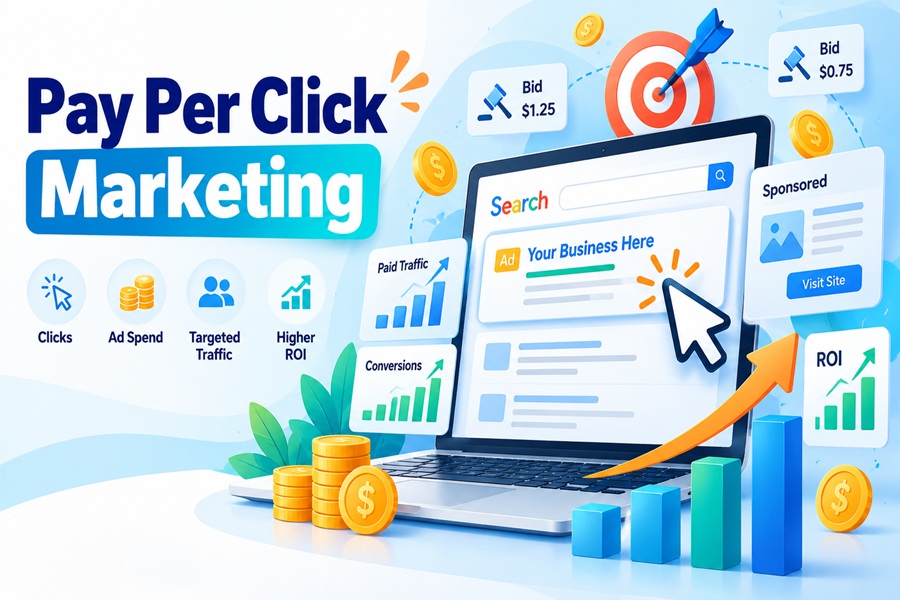
Start with the number that should make every advertiser pause. In one recent benchmark study of more than 13,000 search campaigns, the average cost of a single click was about $5.42. At that price, a hundred careless clicks cost more than most people spend on a weekly shop.
Pay per click marketing, usually shortened to PPC, is a model where you pay an ad platform only when someone clicks your ad, instead of paying for the display itself. That sounds like a bargain, and it can be. It can also be an expensive way to learn that your landing page does not convince anyone. The difference comes down to understanding what actually happens between a search and a sale.
What happens in the half second after a search
Every time someone types a query on a search engine, an automated auction runs. Advertisers who want to appear for that query compete, but the highest bid does not simply win. The platform scores each ad on its likely usefulness to the searcher.
Three things drive that score:
- Your bid, which is the most you are willing to pay for a click.
- Expected click through rate, meaning how likely people are to choose your ad.
- Relevance and landing page experience, meaning how closely your ad and page match what the searcher wanted.
This is why a smaller advertiser with a sharper ad can beat a larger one with a bigger budget, and often pay less per click while doing it.
The main places PPC runs
Search ads capture people who already want something, which is why they convert well. Shopping ads show products with images and prices. Display ads appear across websites and apps and suit awareness. Video ads run on streaming platforms. Social platforms offer their own click based ads, where targeting is built on interests and behavior rather than searches.
Intent differs sharply between these. Someone searching for “emergency plumber near me” is ready to call. Someone scrolling a feed is not, so social ads usually need a softer, more interesting message.
What the numbers look like in 2026
The latest large benchmark gives a useful, if US based, reference point for search advertising:
| Metric | Average |
|---|---|
| Cost per click | $5.42 |
| Click through rate | 6.64% |
| Conversion rate | 8.18% |
| Cost per lead | $66.69 |
Two details deserve attention. Costs vary widely by industry, with legal services among the most expensive at roughly $9.87 a click. And after years of rising lead costs, the average cost per lead fell for the first time in about five years, helped by conversion rates improving in most industries. Treat these averages as a ceiling to compare against your own market, since many regions see lower costs.
Automation has taken over the steering wheel
Google now treats automated bidding, Performance Max and AI Max for Search as the default route for many campaigns. Around 30 percent of search spend is reported to flow through these automated formats, and Google’s own testing claims average gains of roughly 14 percent more conversions from AI Max and 27 percent from Performance Max at similar cost targets. Treat vendor claims with care, but the direction is clear.
What this means in practice is that your inputs now matter more than your tweaking. The system learns from your conversion tracking, your creative assets, your audience signals and your first party data. If those inputs are weak, automation simply scales the weakness faster.
The AI Overview problem
Search results increasingly show an AI generated summary above the usual listings. Independent measurement suggests paid click through rates on such queries have dropped sharply, from near 20 percent to about 6 percent. The result is more competition for fewer prominent slots. Advertisers respond by tightening targeting, strengthening brand search and making sure their ads still earn a click when the answer is partly given on the page.
Setting up a campaign that respects your money
- Define one conversion. A phone call, a form fill or a purchase. Without it, automation has nothing to learn from.
- Start with intent. Begin with keywords close to buying, then widen once you see what converts.
- Write ads that match the page. If the ad promises a free quote, the page should open with a free quote.
- Build a landing page for one job. Remove menus and distractions that pull visitors away from the action.
- Add negative keywords. Block searches such as “free”, “jobs” or “how to make” if they bring the wrong crowd.
- Set a daily budget you can defend. Give each campaign enough to gather data, but not enough to hurt if the first week disappoints.
Where money quietly leaks
- Invalid clicks. Estimates suggest roughly one in ten clicks may not come from a genuine prospect, so watch for odd spikes and use exclusions.
- Broad matching without guardrails. The system may chase loosely related searches.
- Mismatched tracking. If your ad platform, analytics tool and CRM report different numbers, you cannot tell what is working.
- Ignoring mobile. A page that loads slowly on a phone loses the click you just paid for.
- Stopping too early. Judging a campaign after two days rarely tells you anything.
Measuring what matters
Clicks and impressions feel productive but do not pay bills. Look at cost per acquisition, return on ad spend, lead quality and customer lifetime value. A campaign with a higher cost per lead can still be better if those leads become loyal customers. Connect your ad data to your sales records so you can see which keywords bring revenue, not just visits.
PPC and SEO are not rivals
Paid search buys speed. Organic search builds lasting visibility. Used together they share data: keywords that convert in ads can guide content, and strong organic pages can improve landing page quality for ads. Brands that appear in both paid and organic results also tend to look more trustworthy.
A last thought on spending wisely
PPC rewards patience, clear goals and honest measurement. The platform will happily spend whatever you allow. Your job is to make sure every click lands on a page that deserves it, and to read the results without wishful thinking.