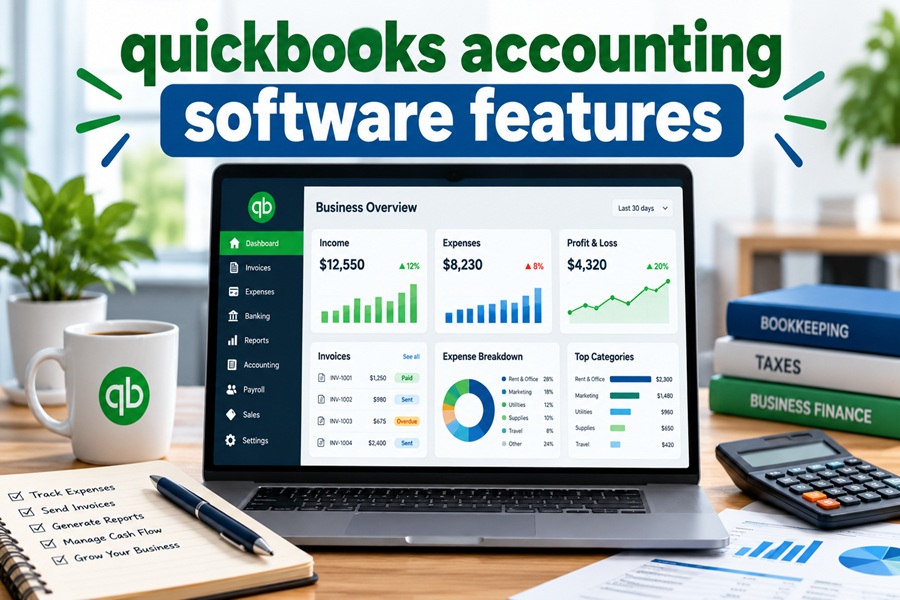
QuickBooks is not really one product. It is a ladder of plans, and almost every feature you read about on a review site lives on a specific rung. A small retailer who signs up for Simple Start because a blog praised QuickBooks inventory tools will find no inventory tools at all. A five person agency on Essentials will hit the user limit the day they hire a sixth person.
Understanding QuickBooks accounting software features means understanding which plan opens which door. Here is the map, organized by the jobs a business actually needs done.
The Plans and What They Cost Now
Intuit raised list prices for Essentials, Plus and Advanced for renewals on or after August 1, 2026. Free, Lite and Simple Start kept their prices.
| Plan | List price per month | Users | Built for |
|---|---|---|---|
| QuickBooks Free | $0 | 1 | Very early self employed users |
| Solopreneur or Lite | About $20 | 1 | Sole proprietors separating business and personal money |
| Simple Start | $38 | 1 | New businesses needing a full small business ledger |
| Essentials | $85 | 3 | Service businesses with bills and time tracking |
| Plus | $140 | 5 | Inventory, projects and budgeting |
| Advanced | $340 | 25 | Teams needing roles, approvals and automation |
Promotional discounts often lower the first few months, but renewals return to list price. Intuit also raises prices most summers, so the numbers above are a snapshot.
Getting Paid
Every plan from Simple Start upward includes invoicing, estimates, sales receipts and customer records. Invoices can carry a payment link through QuickBooks Payments, which is billed per transaction rather than monthly. Intuit lists rates of 2.8 percent for invoiced card and digital wallet payments, 1 percent for ACH bank transfers with a $15 maximum, 2.3 percent for in person card payments and 3.3 percent for keyed card entries.
Intuit Assist, the AI layer inside QuickBooks, can draft invoices and estimates, send payment reminders automatically and nudge customers who are late. Recurring invoices for monthly clients are available from Essentials upward in many setups, which helps subscription style service businesses.
Tracking Spending and Paying Bills
Simple Start captures expenses, receipts and bank transactions but does not manage bills you owe on a schedule.
Essentials adds full bill management, letting you enter vendor bills, track due dates and schedule payments. This is the feature that often pushes service businesses up from Simple Start.
Advanced adds approval workflows so bills can require a manager’s sign off before payment, and Intuit’s August update reportedly bundled premium bill pay and payroll tiers into the Advanced plan.
Receipt capture through the mobile app is available across plans. You photograph a receipt, and QuickBooks reads the vendor, date and amount and suggests a match in the bank feed.
Keeping the Books Accurate
This is the heart of QuickBooks, and most of it is available from Simple Start.
- Bank feeds that pull transactions automatically from connected accounts and cards
- Bank rules that categorize repeat transactions without your input
- Reconciliation tools to match the books against bank statements
- Chart of accounts customization
- Audit log showing who changed what and when
Since July 2025, Intuit has rolled out a set of AI agents across QuickBooks Online. The Accounting Agent categorizes transactions, assists reconciliation and flags anomalies. A Payments Agent handles reminders and collections, a Customer Agent helps with leads and follow ups, and a Finance Agent produces cash flow and performance insights on higher plans. In late October 2025, Intuit added Intuit Intelligence, which lets users type commands in plain language. These tools save real time, but they make mistakes on unusual transactions, so a weekly review still matters.
Managing People
Payroll is a separate subscription on most plans, sold in Core, Premium and Elite tiers with features like same day direct deposit and tax penalty protection on higher tiers.
Time tracking begins on Essentials, letting staff log hours against customers. QuickBooks Time, a separate product, adds GPS crew tracking and scheduling for field businesses.
Contractor tracking and 1099 forms are included across business plans. This matters now because the reporting threshold for Form 1099 NEC and 1099 MISC rose from $600 to $2,000 for payments made in 2026. QuickBooks tracks totals per vendor so you can see who crosses the line.
Inventory and Projects
These are the signature features of Plus, and they are the main reason product and project businesses choose it.
Inventory tracking covers quantities on hand, reorder alerts, cost of goods sold and purchase orders. It handles straightforward stock well. Businesses with manufacturing, lots or complex warehouses often add a dedicated inventory app.
Projects let you group income, expenses and labor by job to see profit per project. Contractors, agencies and consultants lean on this heavily.
Class and location tracking split results by department, service line or branch.
Budgeting lets you set targets and compare them against actual results.
Advanced Tools for Larger Teams
Advanced is built for businesses with a real finance function. It adds custom user roles so staff only see what they need, workflow automation for approvals and reminders, batch actions for invoices and expenses, deeper custom reporting, spreadsheet sync, a dedicated support experience and room for 25 users. It is also where several of the more capable AI features sit, including fuller versions of the Finance and Project Management agents.
Businesses that outgrow Advanced usually look at Intuit Enterprise Suite or move to a mid market platform.
Reporting Across the Ladder
Simple Start includes core reports like profit and loss, balance sheet and cash flow. Each step up adds depth. Essentials adds more detailed reports, Plus adds project and class reporting, and Advanced adds custom report building and performance dashboards.
A Word on QuickBooks Desktop
QuickBooks Desktop still exists, but its role is shrinking. Intuit stopped selling new Desktop Pro Plus, Premier Plus and Mac Plus subscriptions after September 30, 2024, raised remaining Desktop prices in February 2026, and made its newer online platform the default for new customers. Desktop Enterprise remains in use for heavy inventory and industry specific needs.
Features People Pay For and Rarely Use
Accountants who review QuickBooks subscriptions often find businesses on Advanced using it like Plus, or on Plus without touching inventory or projects. Before renewing, open your plan and ask which features you used in the last three months. If the honest answer is invoices, bank feeds and reports, a lower tier may cover you. If you are exporting data to spreadsheets to track jobs or stock, an upgrade might save more time than it costs.
QuickBooks rewards the business that knows what it needs. Pick the rung that matches your daily work, and you get one of the most complete small business accounting systems available. Pick the wrong rung, and you either miss the features you came for or pay every month for ones you never open.